
JEPANGBET Membahas Variasi Tema dan Identitas Visual Permainan
Sat, 12 Sep 2026

Follow the stories of academics and their research expeditions
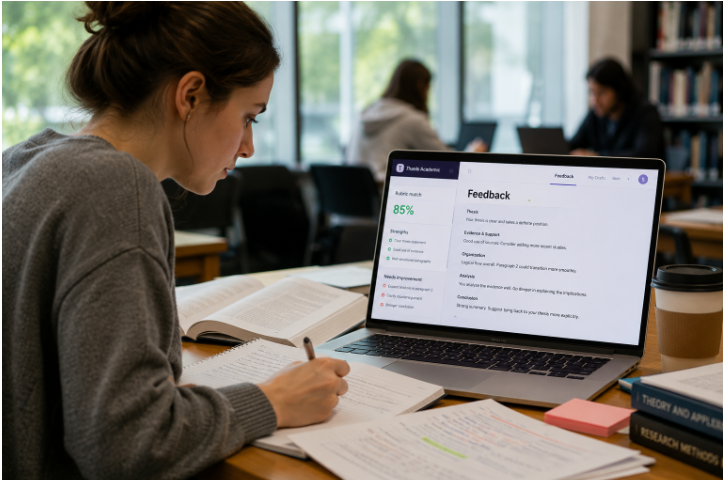
Artificial intelligence has quickly become a common part of student life. From brainstorming ideas and summarizing research articles to improving grammar and explaining difficult concepts, AI tools are now used by students across a wide range of academic disciplines. As these technologies become more accessible, universities are facing a new challenge. Instead of asking whether students use AI, institutions must determine how AI is being used and how academic integrity can be maintained in this changing environment.
The conversation has shifted from simply detecting AI-generated content to developing better ways of evaluating the learning process itself. Universities increasingly recognize that focusing only on the final assignment is no longer enough. To protect educational standards while encouraging responsible innovation, many institutions are exploring ways to require stronger evidence of the work students complete throughout the learning journey.
AI-powered tools have become part of everyday academic life. Students use them to organize ideas, understand difficult subjects, generate outlines, translate content, improve writing, and review coursework before submission. These applications save time and provide additional support, particularly for students balancing coursework with jobs or other responsibilities.
Students can also use an AI poster tool to create visually engaging materials for academic presentations and projects.
Why Detection Alone Is No Longer Enough
Many educational institutions initially responded to AI by searching for tools that could identify AI-generated writing. However, these detection systems often produce inconsistent results and cannot reliably determine how much AI contributed to a student's work.
False positives may incorrectly identify original student writing as AI-generated, while sophisticated AI-assisted content may go undetected. Because of these limitations, universities are beginning to focus less on identifying AI and more on understanding the complete learning process behind each assignment.
Rather than asking whether AI was involved, educators are increasingly asking whether the student demonstrated genuine understanding, critical thinking, and independent learning throughout the project.
Proof of process refers to documenting the steps students take while completing academic work. Instead of evaluating only the finished paper, instructors examine evidence showing how the assignment developed from initial ideas to the final submission.
This approach encourages transparency while giving educators greater confidence that students actively participated in the learning process.
Examples of process documentation may include research notes, brainstorming sessions, early outlines, multiple drafts, instructor feedback, revision history, annotated sources, reflective journals, and project milestones. Together, these materials create a clearer picture of how students developed their ideas over time.
Artificial intelligence is neither inherently good nor bad in education. Like calculators, search engines, and grammar-checking software before it, AI can become a valuable academic tool when used responsibly.
Universities increasingly recognize that banning AI entirely is unrealistic. Instead, institutions can establish clear guidelines explaining acceptable uses. Students may be encouraged to use AI for generating ideas, reviewing grammar, summarizing information, or improving organization while remaining responsible for analysis, interpretation, original arguments, and final decision-making.
Clear expectations help students understand where AI can support learning without replacing critical thinking or academic responsibility.
Traditional essays completed outside the classroom may no longer provide enough evidence of authentic learning. Universities are therefore exploring alternative assessment methods that better demonstrate student understanding.
These methods include oral presentations, project demonstrations, reflective essays, research portfolios, classroom discussions, collaborative projects, practical assignments, and staged submissions completed over several weeks.
When students explain their reasoning, describe their research choices, and defend their conclusions, instructors gain stronger evidence of genuine learning regardless of whether AI tools were used during preparation.
Digital portfolios provide another effective way to demonstrate academic development. Instead of submitting only a final document, students can collect all stages of their work in one organized location.
A portfolio may include research plans, literature reviews, annotated references, concept maps, early drafts, instructor comments, revision summaries, and personal reflections explaining how ideas evolved throughout the project.
These portfolios highlight the learning journey while making it easier for instructors to evaluate student engagement and intellectual growth.
Open communication between students and educators is becoming increasingly important. Rather than discouraging conversations about AI, universities can encourage students to disclose how AI tools contributed to specific tasks.
Students might briefly explain whether AI assisted with brainstorming, proofreading, language editing, or summarizing background information. This level of transparency promotes academic honesty while helping instructors distinguish between appropriate assistance and excessive dependence on automated systems.
Trust grows when expectations are clearly communicated and consistently applied across courses.
Faculty members also need support as AI becomes more common in higher education. Many instructors require training to understand AI capabilities, recognize appropriate classroom applications, and design assessments that emphasize learning rather than simple content production.
Professional development programs can help educators integrate AI responsibly while maintaining rigorous academic standards. Sharing best practices across departments also encourages consistency throughout the institution.
Universities should view AI primarily as a teaching challenge rather than solely as a disciplinary issue. Some even turn to an ai image generator to create diagrams or visuals for presentations that accompany their written work.
Providing guidance on ethical AI use, digital literacy, citation practices, and responsible research habits helps students develop valuable lifelong skills instead of relying on punishment alone.
Educational support encourages responsible decision-making while preparing graduates for workplaces where AI will likely become a standard professional tool.
Artificial intelligence is already transforming industries including healthcare, engineering, business, finance, education, law, and technology. Graduates entering these fields will likely work alongside AI systems throughout their careers.
Universities therefore have an opportunity to teach students how to use AI thoughtfully, evaluate AI-generated information critically, recognize its limitations, and apply independent judgment when making important decisions.
These skills may become just as important as traditional academic knowledge in the modern workforce.
Academic integrity remains a fundamental principle of higher education, but maintaining integrity does not necessarily require rejecting new technologies. Instead, universities can balance innovation with accountability by emphasizing authentic learning, critical thinking, transparency, and documented evidence of student work.
Assessment methods that capture the complete learning process provide stronger evidence of student achievement than relying exclusively on final written assignments.
Artificial intelligence is already a regular part of higher education, making the question of whether students use AI increasingly irrelevant. The more important challenge is ensuring that students continue to develop genuine understanding, analytical skills, and independent thinking while using these new technologies responsibly.
By placing greater emphasis on proof of process through drafts, reflections, research documentation, portfolios, and staged assessments, universities can preserve academic integrity without resisting technological progress. Instead of competing against AI, higher education can evolve to evaluate what matters most: how students learn, think, solve problems, and grow throughout the educational process.
Sat, 12 Sep 2026
Sat, 12 Sep 2026
Start learning with Acadomi! Explore thousands of affordable courses on any topic, anytime, and anywhere. Join our community and unlock your potential today!
Leave a comment