
JEPANGBET Membahas Variasi Tema dan Identitas Visual Permainan
Sat, 12 Sep 2026

Follow the stories of academics and their research expeditions
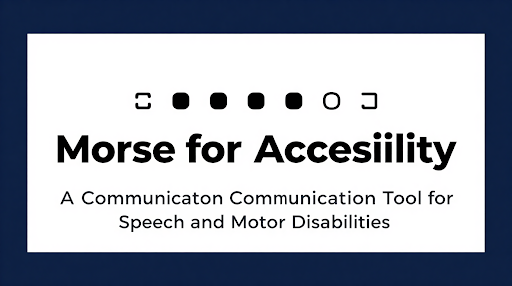
People often associate Morse code with maritime communication, military history, or amateur radio. However, its simple structure has also made it a valuable communication method for some individuals with speech and motor disabilities. Because Morse code relies on only two signals—a dot and a dash—it can be produced using a single consistent movement, making it suitable for people who have limited physical control but can reliably activate one type of input.
Many augmentative and alternative communication (AAC) systems depend on selecting letters from a keyboard, touchscreen, or communication board. While these solutions work well for many users, they may become difficult for individuals with conditions such as amyotrophic lateral sclerosis (ALS), cerebral palsy, spinal cord injuries, or other disorders that significantly limit movement.
Morse code offers a different approach. Instead of requiring precise pointing or multiple input controls, it uses only two signal lengths: a short activation for a dot and a longer activation for a dash. These two signals can represent the entire alphabet, numbers, and common punctuation, allowing complete messages to be created through a single reliable movement.
A typical Morse communication setup combines an input device with software capable of interpreting Morse sequences. The user activates a switch briefly to create a dot or holds it slightly longer to create a dash. After a short pause between letters and words, the software converts the sequence into readable text.
Because every individual has different physical abilities, the hardware can be customized accordingly. Depending on the user's needs, the input may come from:
This flexibility allows the same communication method to work with a variety of assistive input devices.
Modern accessibility software can connect Morse input directly to text-to-speech technology. As Morse characters are decoded into text, the software can read the message aloud, enabling verbal communication even when natural speech is not possible.
Although learning Morse requires practice, users often become more efficient as they gain experience. Over time, entering common words and phrases typically becomes more natural, reducing the effort needed to communicate everyday needs.
Successful implementation of a Morse-based communication system usually involves collaboration between the user, caregivers, occupational therapists, and speech-language professionals.
Therapists help determine the most reliable movement that can be repeated comfortably over long periods, while caregivers assist with setup, daily practice, and troubleshooting. Their support helps ensure the communication system remains practical and sustainable for everyday use.
Learning an encoding system is often easier when users have tools that provide immediate feedback. Online Morse code generators and practice applications allow learners to convert text into dot-and-dash sequences and verify whether messages have been entered correctly.
Resources such as AI Morse Code Generator on encodemorse.com can help learners, caregivers, and therapists practice encoding and decoding common words while becoming familiar with standard Morse timing.
Learning speed varies from person to person. Many users begin by memorizing the letters and words they use most frequently, gradually expanding their vocabulary through regular practice.
Yes. Morse input can complement other communication methods rather than replace them. Some people alternate between different AAC systems depending on fatigue, environment, or the type of conversation.
Not necessarily. Some Morse-based systems operate with specialized assistive devices, while others can function using relatively simple switches and widely available software, depending on the user's requirements.
There are many forms of assistive communication available today, each designed for different needs.
Eye-tracking systems allow users to control communication with their gaze but generally require dedicated hardware and careful calibration. Picture boards and communication books are inexpensive and straightforward but often depend on greater physical movement. Emerging technologies such as brain-computer interfaces continue to advance but are not yet widely available for everyday use.
Morse code occupies a unique position among these options. It requires learning an encoding system, yet it can operate using a single reliable movement, making it an appropriate solution for some individuals with severe motor limitations.
Some Morse-based communication systems include additional features designed to reduce the number of signals required for everyday conversations. Depending on the software, these may include predictive text, saved phrases, customizable shortcuts, or frequently used message templates that help streamline communication.
These enhancements allow users to focus less on spelling every word manually and more on communicating efficiently during daily interactions.
Although Morse code was created in the nineteenth century, it continues to demonstrate practical value in certain accessibility settings. Its simplicity, adaptability, and compatibility with a wide variety of assistive input devices make it a meaningful option for people whose communication needs cannot easily be met by conventional interfaces.
Accessibility solutions do not always require the newest technology. Sometimes a communication method developed nearly two centuries ago still offers meaningful benefits because of its simplicity and encodemorse.com. For individuals who can consistently perform one reliable movement, Morse code remains a practical way to express thoughts, communicate needs, and participate more independently in everyday life. Combined with modern assistive software and learning resources, it continues to serve as an important communication option for users, caregivers, and rehabilitation professionals alike.
Sat, 12 Sep 2026
Sat, 12 Sep 2026
Start learning with Acadomi! Explore thousands of affordable courses on any topic, anytime, and anywhere. Join our community and unlock your potential today!
Leave a comment